CHAPTER 01
Start playing
Wiggle is a small touch instrument. You do not need a keyboard, an account or a musical background. Explore by ear, or turn on note labels when you want more guidance.
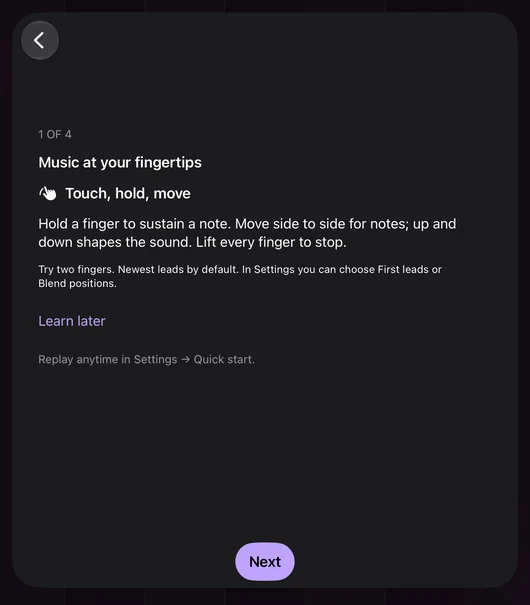
- Open Wiggle. The first-time Quick start explains the gestures and lets you practice the corner shortcuts without changing your settings.
- Turn off Silent Mode, check the sound controls and choose a comfortable volume. Start quietly, especially when playing with a child.
- Touch the play area and keep your finger down to hold a note. Slide sideways to change pitch; slide up or down to change the tone. Lift all fingers to end the live note. A short release or echo may fade out.
- Try Bloom, Bubble and Sunny. Each world has its own starting sound and visuals. Your changes save automatically on this device.
With Vertical notes on mobile, or Up and down note direction on Watch, the axes swap: bottom-to-top movement chooses pitch, and sideways movement shapes the tone.
Replay the introduction anytime from Settings > Quick start. You can choose Learn later and start playing immediately.
CHAPTER 02
Find your controls
The instrument is the same idea across devices. The Watch keeps its controls tucked away; the larger mobile layout also has a regular toolbar.
- Apple Watch
- Triple-tap the top-left gear with one finger for Settings. Triple-tap the top-right world icon to cycle Bloom, Bubble and Sunny. Use one or two fingers on the playing surface.
- iPhone and iPad
- Use the Settings button in the top toolbar, the speaker button to mute or enable music, and the world buttons below the canvas. Expand Loop & jam for phrase controls.
- Full-screen mobile play
- The toolbar and regular controls disappear. Triple-tap the top-left gear for Settings or the top-right world icon to change worlds. These shortcuts do not require leaving full-screen play.
- VoiceOver
- The corner shortcuts have an accessibility action: activate them normally instead of performing the visual three-tap gesture. Use the labeled Settings controls to adjust the instrument.
Current development minimums are watchOS 11 and iOS/iPadOS 17. The Watch app works independently of the mobile app. iPad does not need an Apple Watch. Final supported devices will be listed at release.
Full-screen play and triple-tap controls are not a device lock. The Crown, side button, Home gesture and other system controls still belong to Apple.
CHAPTER 03
Short, shared play
Choose the sound and volume yourself, then let the playing surface do the work. Wiggle is a creative toy, not a developmental or medical tool.
- Try taking turns: make a little sound, then invite an answer.
- Copy a rhythm, name a color or explore one slow sweep together.
- Stay nearby, follow the child's interest, and stop when they look away or seem uncomfortable.
On Watch, leave Show notes off for a simpler visual experience. Choose Calm visual energy, reduce background movement if desired, and disable Crown volume changes to protect the level you set.
On iPhone or iPad, enable Full-screen play. For a separate system restriction, use Apple's Guided Access as described below. Wiggle itself cannot prevent someone from leaving the app.
Do not use Watch Water Lock while playing: it disables touchscreen interaction. Covering much of the Watch screen can invoke a watchOS dismissal gesture; this is why its intended multi-finger interaction uses one or two fingers.
CHAPTER 04
Choose your notes
Open Settings > Music & loops on Watch, or Settings > Music on iPhone/iPad. These musical choices apply to all three worlds, not just the world being customized.
- Key
- Choose the starting pitch, from C through B. Match the key of another instrument or a piece you are playing along with.
- Scale
- World default preserves each world's original note collection. Major pentatonic and Minor pentatonic give a smaller set; Major and Natural minor add more scale notes.
- Octave
- Lower, Original or Higher shifts the entire instrument down or up. It changes the register, not how many notes fit on screen.
- Note range
- Half octave, One octave (default), Two octaves or Three octaves changes the span and number of playable notes. Wider ranges fit more, narrower regions onto the same screen. The count depends on the selected scale and, with World default, the selected world.
- Effect depth
- Controls how strongly the other touch axis changes the tone. Turn it down for a gentler change or up for more expression.
- Tilt
- Optional device tilt adds expression while you touch. Find Tilt in Watch Music & loops, or Tilt adds expression in mobile Play controls. Use Tilt sensitivity to control its strength. Motion is processed locally; tilt alone does not start a note.
For a musician-friendly starting point, choose a key and Major pentatonic, enable Show notes, and try Two octaves. Wider ranges reward more precise touches, especially on the small Watch screen.
On Watch, Note range is also directly below Show notes on the main Settings page. Both entry points change the same saved setting.
CHAPTER 05
See the note you are playing
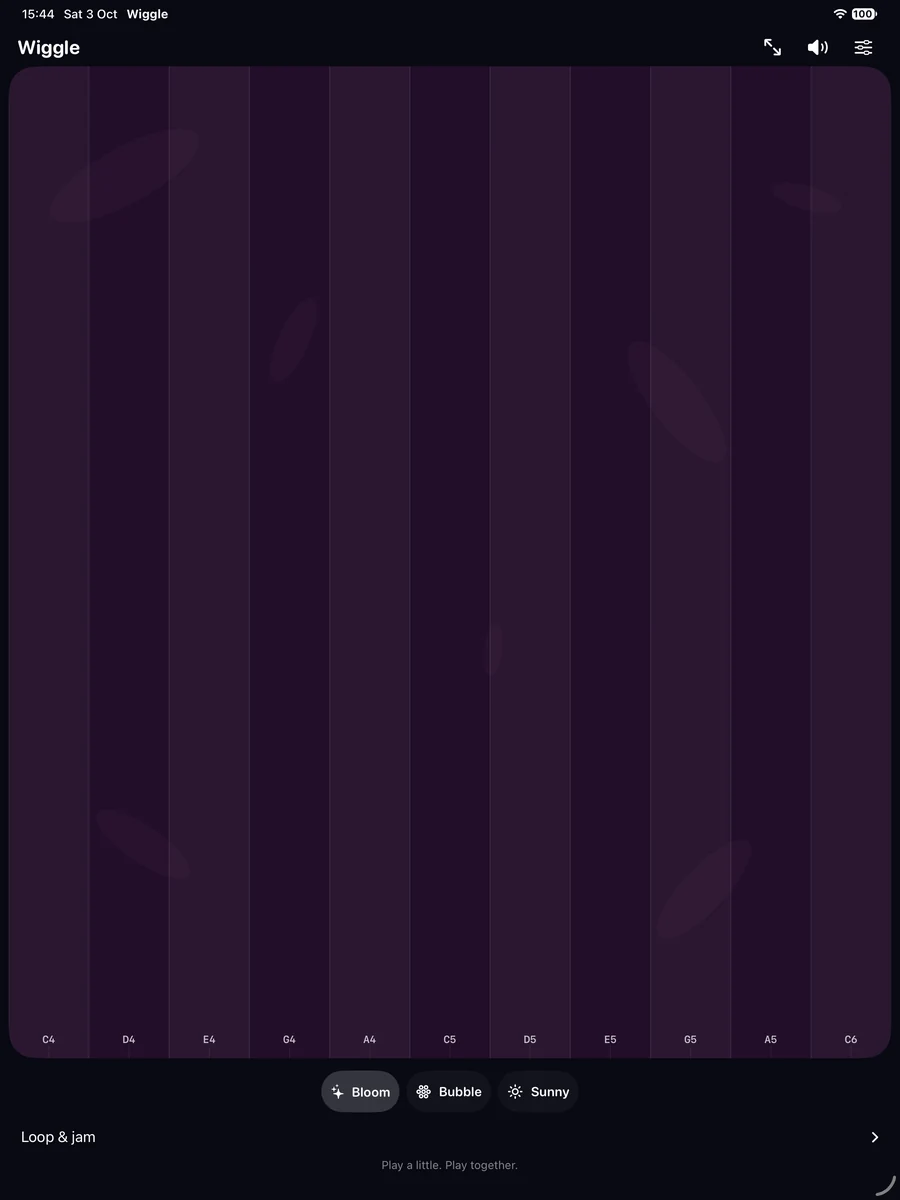
Show notes adds named touch regions to the surface. It is off by default and is independent of your particle choice.
- On Watch, triple-tap the gear and enable Show notes below Touch vibration. You can also find it in Music & loops. On iPhone/iPad, use Settings > Music > Show notes.
- Choose your Note range. Each region corresponds to a playable note. Labels such as C4 include the octave; dense layouts stagger labels so they remain tied to the correct region.
- Touch or slide. The live note's region and label become highlighted. In First leads or Newest leads, the highlight follows the controlling finger; in Blend positions it follows the shared center.
Low notes are on the left by default, or at the bottom when the axes are swapped. The guide updates for your key, scale and range. Lifting all fingers, muting, opening Settings or leaving the foreground clears the live highlight.
The highlight represents live touch input, not recorded-loop playback or a measurement of speaker output. Silent Mode, connected audio devices and volume still affect what you hear.
CHAPTER 06
Decide which finger leads
Wiggle plays one live synth note at a time. Multiple fingers steer that note; they do not create a separate voice for every finger.
- Newest leads (default)
- A new finger takes over the pitch and tone. If it lifts while another finger remains, control passes to the newest remaining finger.
- First leads
- The oldest remaining finger stays in charge. Other fingers wait until the leading finger lifts.
- Blend positions
- The average of the active finger positions controls the note and tone. Adding or moving a finger shifts that shared point.
- Touch guide
- Enable this per world in Customize world > Visual tuning. A solid ring marks the controlling position; dashed rings mark waiting fingers. Blend connects the fingers to their shared center.
On Watch, choose the finger mode in Settings > Play controls > Two fingers. On iPhone/iPad, use Settings > Play controls > Fingers. Releasing every finger ends the live gesture.
The Watch screen is small. A third finger or a palm covering enough of the display may trigger Apple's system dismissal gesture. Use one or two fingers there. The larger mobile canvas supports multiple active fingers.
CHAPTER 07
Make each world your own instrument
Open the Customize entry for your selected world in Settings. In the editor, check the World selector before changing anything. Changes here belong only to that world and save automatically.
- Voice
- Keep World original or choose Soft, Round or Bright as a new starting character.
- Harmonics
- Move from a purer sound toward a richer tone.
- Filter
- Move from warmer to more open and bright.
- Motion
- Adjust the amount of gentle vibrato or movement.
- Space
- Adjust the short echo, from drier to more spacious.
- Envelope > Attack / Release
- Choose a quicker or softer onset and a shorter or more lingering fade. Release is bounded; lifting all fingers still ends the held note.
Hear this sound auditions the selected setup when music is enabled. Reset this world asks for confirmation and restores only that world's sound and visuals. It does not reset the other worlds, your key, scale or volume.
Key, scale, octave, note range, effect depth and general play controls are shared across worlds. Your customized sound character and visual setup are per world.
CHAPTER 08
Choose the look and the particles
In Customize world, visual choices are saved separately for Bloom, Bubble and Sunny. They do not alter pitch, sound or finger ownership.
- Style
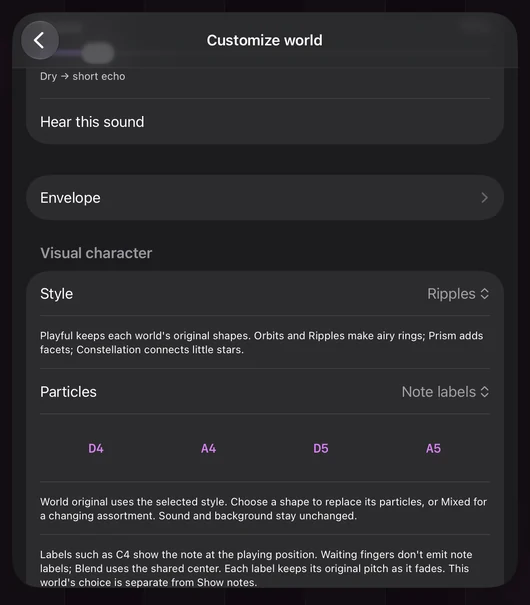
- Playful preserves each world's original art. Orbits, Prism, Ripples and Constellation offer rings, facets or connected stars.
- Particles
- Choose World original, Sparks, Bubbles, Petals, Diamonds, Mixed, Hearts, Music notes, Emoji or Note labels. World original follows the selected style. Mixed varies between sparks, bubbles, petals and diamonds.
- Emoji
- When Emoji is selected, choose one of eight curated symbols: Star, Heart, Flower, Butterfly, Bubbles, Music, Planet or Smile.
- Note labels
- Emit pitch names such as C4 from the playing position. Labels match the key, scale and range when each particle is created, and keep that pitch as they fade. Waiting fingers do not emit these labels; Blend emits from the shared center.
- Color shift / Trail size / Moving background
- Adjust the palette and trail size, or stop the backdrop from moving.
- Visual tuning
- Adjust Trail brightness, Background level and Spread. A background level of zero removes the backdrop. Touch guide can be enabled or disabled separately.
- Visual energy
- Calm, Balanced and Vivid adjust overall particle density in Play controls. This is a general setting, not a per-world style.
Note labels are different from Music notes: Music notes uses a decorative musical-note symbol, while Note labels shows the pitch name. Neither choice automatically turns on the fixed Show notes map.
Low Power Mode and Reduce Motion reduce animation automatically. Choose Calm, reduce brightness or disable Moving background if you prefer a quieter screen.
CHAPTER 09
Sound, volume and the Watch Crown
Wiggle respects Silent Mode. It cannot read the Watch's system Silent Mode state and automatically diagnose silence; the in-app reminder is advice, not a status detector.
- Watch Music and Volume
- Enable Music and set Volume on the main Settings page. Turning Music off silences Wiggle's music independently of touch visuals. Touch vibration is a separate setting.
- Crown > Volume
- In Play controls, assign the Crown to Volume for fine changes to Wiggle's output. Turn Allow volume changes off to protect your chosen level. This does not change the Watch's system-wide volume.
- Other Crown assignments
- Tone & effects adjusts expression; Octave changes register; Off disables Crown rotation within Wiggle play. None of these assignments changes volume.
- World shortcut sound
- An optional Watch note after using the top-right world shortcut. Music must also be enabled. Mobile world changes do not add this chime.
- iPhone / iPad
- Use the speaker button to mute or enable music. Set Wiggle's Volume in Settings > Music, and check the device volume and audio route too.
For no sound: turn off Silent Mode, enable Music, raise volume gradually, touch the play area and check connected headphones or Bluetooth audio. The website demo also needs a user gesture before browser audio starts; on iPhone, turn off Silent Mode to hear it.
Touch vibration is one light Watch haptic at the start of a gesture, not a repeated effect for every note. The Watch haptic mechanism may still make a small mechanical sound.
CHAPTER 10
Record four beats, then play over them
Loop & jam stores a short musical phrase for the current session. It records note events, not the microphone.
- Set the tempo in BPM (beats per minute). On mobile, use Settings > Play controls > Loop tempo; on Watch, use Music & loops.
- On iPhone/iPad, expand Loop & jam and choose Record 4 beats. On Watch, choose Record 4 beats in Settings > Music & loops; the app returns you to play.
- Touch and play a phrase. Recording finishes after four beats. On mobile you can also choose Finish recording. Wait for Phrase ready.
- Choose Play loop. On Watch, return to Music & loops to start it. Play live notes over your phrase. Lifting your fingers ends the live note, not the intentionally playing loop.
On mobile, Stop loop stops playback and Clear removes the phrase. On Watch, opening Settings stops playback; Clear phrase removes it. Leaving the foreground also stops playback.
An empty recording does not become a loop. Phrases remain in memory: they are not a saved song library, are not sent to another device, and may disappear when the app closes. Version 1.0.0 does not export audio or MIDI files, record microphone audio or synchronize a duet between devices.
CHAPTER 11
Full-screen play and Guided Access
Full-screen play hides Wiggle's regular mobile controls. Guided Access is Apple's separate one-app restriction; use it only after you know how to end the session.
- In Wiggle, choose your world and volume, then enable Full-screen play with the toolbar button or its Settings toggle.
- On iPhone/iPad, open system Settings > Accessibility > Guided Access. Enable it and configure a passcode.
- Return to Wiggle. Triple-click the side button, iPad top button or older device's Home button. Choose Guided Access if prompted.
- In Session Settings (or Options), keep Touch enabled. Restrict buttons or set a short time limit if useful, then Start. A previous session can reuse its settings.
- To finish, triple-click and authenticate, then choose End. On iOS/iPadOS 18 or earlier, Apple specifies double-click instead. Check the exit steps on your device before handing it over.
To return to the regular Wiggle interface, triple-tap the top-left gear and turn Full-screen play off. Guided Access must be ended separately.
Stay nearby. Apple says emergency calls and Crash Detection are unavailable during Guided Access; end the session to use them. This feature does not exist as a Wiggle Watch lock.
CHAPTER 12
Copy settings between iPhone and Watch
Both apps can play independently. Sharing is an explicit copy, not continuous live synchronization.
- Pair your Watch with its iPhone through Apple's normal setup, and install compatible Wiggle builds on both.
- On iPhone, use Settings > Optional Watch companion > Send these settings to Watch. On Watch, use Settings > Companion > Send to iPhone.
- Read the connection status. If the other device is reachable, delivery can be immediate; otherwise the latest settings snapshot is queued.
Sending copies all three customized sound and visual setups plus shared musical choices, including the note range and Show notes preference. It does not copy volume, live touches, local finger/axis preferences or a recorded phrase.
Nothing is sent merely because you edit a setting. iPad does not pair with Apple Watch and cannot use this companion transfer. Update both apps together when using new setting options.
CHAPTER 13
Troubleshooting and privacy
- No sound
- Check Silent Mode, Music/mute, Wiggle volume, device volume and connected audio devices. Touch again after an audio interruption.
- Watch closes under several fingers
- A cover-to-dismiss system gesture can look like a crash. Try one or two fingers without covering most of the display. If the app exits during ordinary play, report the device and steps to support.
- Settings seem different from these pictures
- Confirm your app version and device. Watch Settings is compact; phone/tablet layout, menu style and text size differ. Scroll to reveal additional controls.
- Changing one world affects the others
- Key, scale, note range, Show notes and general play controls are shared. Customize world sound and visual choices are independent. Check which World is selected before editing or resetting.
- Nothing plays after returning
- Wiggle stops expensive audio and interaction work when inactive. Return to the foreground and touch again; it does not automatically resume a held note.
The native app needs no account and has no ads, analytics, tracking or developer-operated sound server. Preferences stay on the device. Optional paired-device settings transfer is deliberate. Tilt is processed locally and phrases contain musical events, not microphone recordings.
The website demo is a simplified browser sketch, not the complete native synth, settings editor or a Watch-speaker simulation. Website hosting and any optional adult launch emails have their own privacy details.
For help, email support@playwiggle.com with your device, OS version, Wiggle version and steps to reproduce. Do not include passwords or a child's personal information. Support messages do not subscribe you to launch emails.
Keep it playful.
You don't need to master every setting. Start with one world, make a little sound, and explore from there.
Back to the beginning ↑